

I’m going to settle this debate properly — not with theory, but with what actually happened when I tried both methods myself.
I started with the debt avalanche. It’s mathematically optimal. I read the research. I built the spreadsheet. I attacked my highest interest rate card first.
For six months I did everything right. And at the end of those six months I checked my progress and felt — nothing. I’d made real progress on paper. But emotionally I felt like I was getting nowhere because I’d only eliminated one account, and it wasn’t even the smallest one.
I switched to the snowball. I paid off three small accounts in the next three months.
And something clicked. I started actually looking forward to making extra payments. I stopped dreading the debt. The motivation shift was real and it changed the pace of my entire payoff.
The Technical Explanation First
The Debt Avalanche
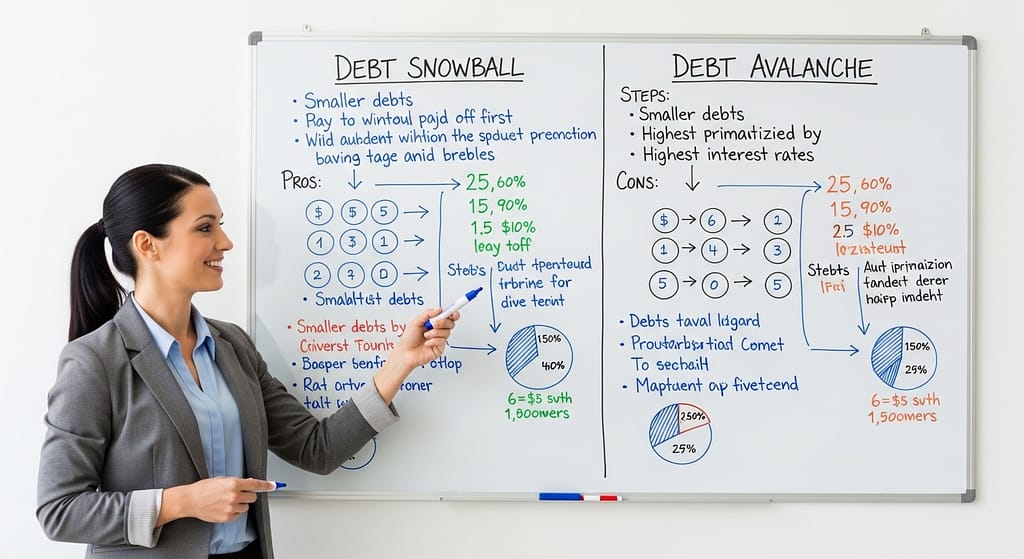
List debts from highest interest rate to lowest. Pay minimums on all. Direct every extra dollar to the highest-rate debt. When that’s gone, roll those payments into the next highest rate.
Mathematically this minimizes total interest paid. Over a large debt with significant rate differences the savings can be substantial — sometimes thousands of dollars.
The Debt Snowball
List debts from smallest balance to largest. Pay minimums on all. Attack the smallest balance with every extra dollar. When it’s gone, roll everything into the next smallest.
Doesn’t minimize interest. But each eliminated account creates a motivational win that keeps you going through the long months of debt payoff.
The Real-World Comparison With Numbers
Let’s say you have these three debts with $400 per month available:
- Credit Card A: $800 balance at 24% APR — $30 minimum
- Credit Card B: $4,500 balance at 19% APR — $90 minimum
- Personal loan: $9,000 balance at 11% APR — $180 minimum
- Extra available beyond minimums: $100 per month
With the Avalanche: Attack Card A first anyway since it’s highest rate. Pay it off in about 6 months. Then attack Card B. Then the loan. Total interest paid: roughly $2,900. Time to debt free: about 34 months.
With the Snowball: Also attack Card A first since it’s also the smallest. Same order in this case — but you’d feel that first payoff as a win at 6 months much more viscerally. In cases where order differs, snowball typically takes 1 to 3 months longer and costs 5 to 15% more in interest.
The Research on Which Actually Works
Here’s the interesting part. A Harvard Business Review study found that people using the debt snowball method are more likely to successfully complete their debt payoff journey than those using the avalanche — even though the avalanche saves more money.
Why? Because finishing is worth more than optimizing.
A debt avalanche that you abandon at month eight is worse than a debt snowball you complete. The best debt payoff method is always the one you’ll actually stick with for two or three years.
My Honest Conclusion
If you’re analytical, motivated by numbers, and have high willpower — use the avalanche. It saves more money and that’s genuinely meaningful over thousands of dollars of debt.
If you need wins to stay motivated — and most humans do — use the snowball. The completion rate is higher. The emotional experience is better. And you’re more likely to actually become debt free.
Can I switch between the two methods mid-payoff?
Yes — I did exactly this. There’s no rule saying you have to stick with one method forever. If the avalanche is draining your motivation, switch to the snowball. The most important thing is that you keep making extra payments.
What if my highest interest debt is also my smallest balance?
Then both methods give you the same answer — attack it first. The methods only diverge when the smallest balance and the highest interest rate are on different debts.
You might also like: How to Pay Off Credit Card Debt Fast | How to Get Out of Debt on Low Income | Zero-Based Budgeting for Beginners | How to Improve Your Credit Score