
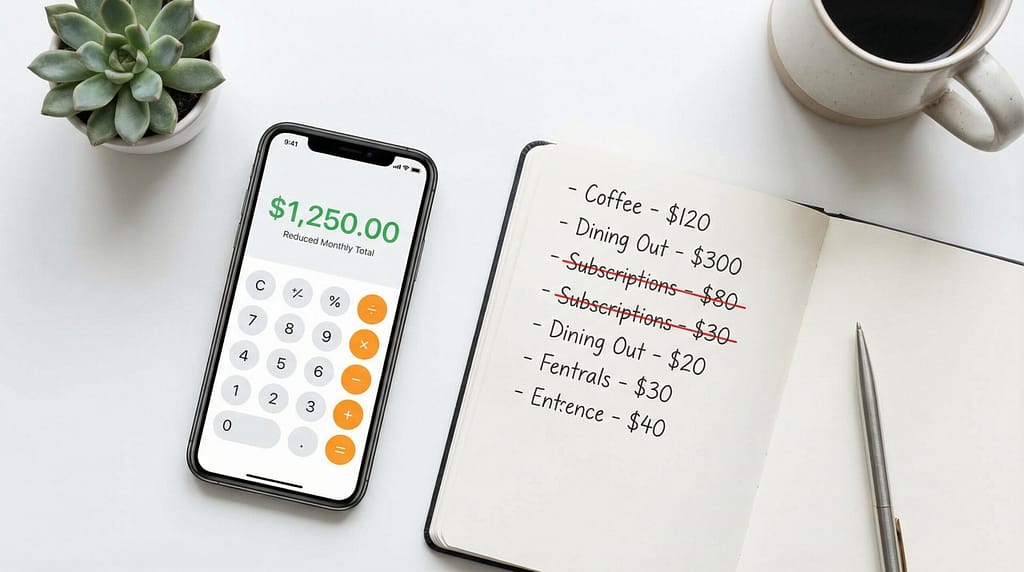


I cut my monthly expenses by $680 without giving up anything I actually cared about. Here are the exact expenses I cut, what I kept, and how to find your own savings.
Category: Budgeting | Tags: cut monthly expenses, reduce monthly bills, lower living costs, how to spend less money, monthly expense reduction, cut household bills, save money monthly
The conventional advice for cutting monthly expenses is predictable and mostly useless. Stop buying coffee. Cancel Netflix. Cook more.
That advice saves you maybe $30 to $50 a month if you implement every single suggestion. It’s not enough to genuinely change your financial situation.
Real expense reduction requires going further and being more strategic — targeting the high-cost items, negotiating with providers, and rethinking categories most personal finance articles don’t mention.
Here’s how I cut $680 from my monthly outgoings. Some of it was painful to find. None of it actually hurt to lose.
The Right Order to Attack Your Expenses
Most people start expense cutting with the smallest and most visible costs — the daily coffee, the takeaway, the impulse buys. These are visible but not where the big money is.
The right order is the opposite: start with your largest fixed expenses and work downward. A 10% reduction on a $1,500 rent payment saves $150. A 10% reduction on a $50 gym membership saves $5. Same effort. Thirty times more money.
Category 1 — Housing (Potential Savings: $100 to $500+ per Month)
Housing is the largest expense for most people. Even small percentage changes produce large savings.
- Refinance your mortgage if rates have dropped since you took it out — even 0.5% less on a $300,000 mortgage saves $75+ per month
- Negotiate your rent at renewal — research comparable properties and present evidence when negotiating with your landlord
- Take in a lodger or get a roommate — this can halve your housing costs immediately
- Downsize when your situation allows — moving to a smaller property is the single largest expense reduction available
Category 2 — Bills and Utilities (Potential Savings: $80 to $200 per Month)
Energy Bills
Compare tariffs annually on comparison sites — switching provider typically saves $100 to $400 per year. Lower your thermostat by 2 degrees. Programme your heating schedule properly. These three actions cut the average energy bill by 15 to 25%.
Insurance
Never auto-renew insurance without comparing alternatives. Car insurance, home insurance, and life insurance all reward switchers over loyal customers. Use comparison sites every renewal. Average savings from switching: $100 to $300 per policy per year.
Internet and Phone
Call your internet provider and ask for their best retention deal. Most will drop your rate by $15 to $30 per month rather than lose you. Do the same with your phone contract when it comes up for renewal. Switching from a big carrier to a smaller MVNO (like Mint Mobile in the US or Smarty in the UK) for the same network coverage at 40 to 60% less cost is often the best option.
Category 3 — Subscriptions (Potential Savings: $60 to $150 per Month)
We covered this in detail in a separate article but the short version: audit every recurring charge. The average person has $87 more in subscriptions than they think they have. Cancel anything unused. Downgrade to free tiers where available. Share family plans with family.
Category 4 — Food and Dining (Potential Savings: $100 to $300 per Month)
For most households this is where the largest discretionary cuts exist.
- Switch grocery shopping to a discounter for staples — Aldi and Lidl are 20 to 35% cheaper on equivalent products
- Meal plan before every shop — eliminates both waste and the random mid-week top-up trips
- Cut food delivery entirely for 60 days — the average DoorDash order costs $35+ including fees and tips versus $8 to $10 of ingredients
- Make coffee at home — even a basic espresso machine pays for itself in 3 to 4 weeks versus daily coffee shop visits
Category 5 — Transport (Potential Savings: $50 to $200 per Month)
- Refinance your car loan if your credit score has improved since taking it out
- Switch car insurance at renewal using a comparison site — do this every year
- Reduce fuel costs: keep tyres properly inflated, remove unnecessary weight from the car, plan combined errands
- Consider whether you need your current car — downsizing to a cheaper-to-run or cheaper-to-insure vehicle is often transformative
The Negotiation Calls That Saved Me $180 in One Afternoon
I spent one afternoon calling every service provider I pay monthly. My pitch was always the same: I’ve been a loyal customer, I’m reviewing all my expenses, and I’d like to discuss what’s available to keep my account.
- Internet provider: dropped my monthly bill by $22 with no service change
- Car insurance: matched a competitor quote saving $34 per month
- Mobile phone: moved to a SIM-only plan saving $28 per month
- Gym: offered a 3-month pause instead of cancelling, then negotiated a lower rate on return
Total from phone calls: $84 per month. Took about 2 hours. Most people don’t do this because it feels uncomfortable. The discomfort lasts about 30 seconds per call. The saving is permanent.
Expenses I Deliberately Did NOT Cut
This matters. I did not cut the gym when I was actually going regularly. I did not cut my one remaining streaming service I watch every day. I did not cut the quality ingredients that make cooking at home enjoyable rather than a chore.
Cutting things you genuinely value leads to resentment and budget abandonment. The goal is to eliminate spending that doesn’t add real value to your life — not to punish yourself.
Quick Answers
What monthly expenses can I cut immediately?
The fastest expenses to cut immediately are: unused subscriptions (cancel today), food delivery apps (delete them from your phone), any gym membership you haven’t used in 30 days, and any insurance you haven’t comparison-shopped in the last 12 months.
How much should I spend on monthly expenses?
A common guideline is the 50/30/20 rule: 50% of take-home income on needs, 30% on wants, 20% on savings and debt. If your needs are consuming more than 50% of income, housing and transport are usually the culprits and need addressing first.
Related: Zero-Based Budgeting for Beginners | How to Save Money on Subscriptions | How to Make a Budget for Beginners | How to Stop Impulse Buying