
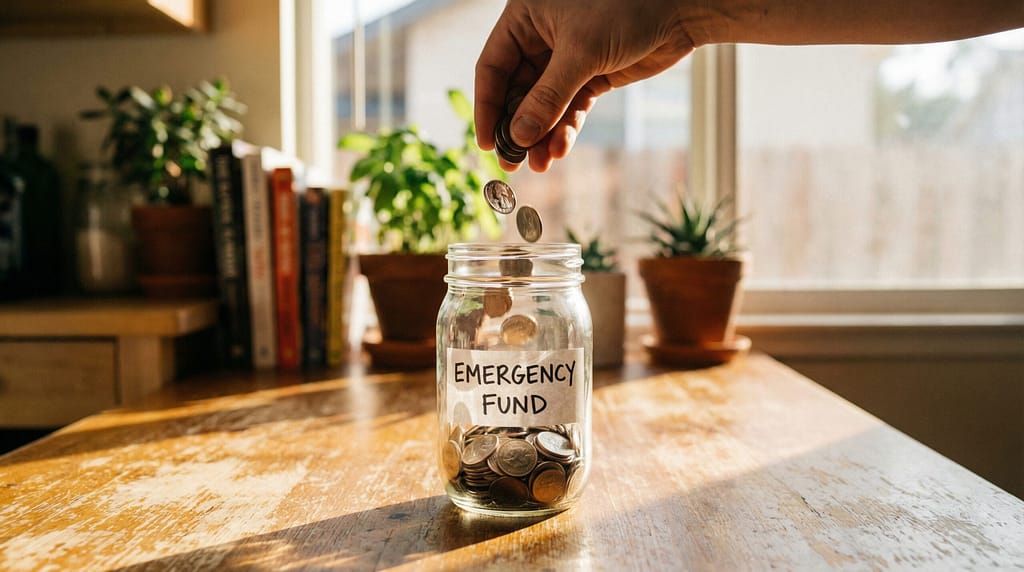


No emergency fund? Here’s exactly how to build one fast — even starting from zero. I went from nothing to $1,000 in 60 days. Here’s the honest step-by-step plan.
Category: Saving Money | Tags: build emergency fund fast, emergency fund tips, emergency savings, how to start emergency fund, $1000 emergency fund, financial safety net, emergency money
There is a specific kind of panic that comes from an unexpected expense when you have no savings.
I know it because I lived it for three years. Car needed a repair — panic. Dentist visit — panic. Boiler breaking in January — actual crisis.
Every unexpected cost went on a credit card because there was nowhere else for it to go. And then I’d spend the next few months paying it off at 22% interest. The same cycle. Every time.
The thing that finally broke the cycle wasn’t a higher salary or a lucky windfall. It was a $1,000 emergency fund that took 60 days to build.
Why $1,000 First — Not 3 Months of Expenses
Most financial advice tells you to save 3 to 6 months of expenses as your emergency fund. That’s the right long-term goal. But if you have nothing right now, telling you to save $15,000 is about as useful as telling someone who can’t swim to cross the Atlantic.
Start with $1,000. Just $1,000.
Here’s why this number specifically. According to multiple financial surveys, the vast majority of common financial emergencies — car repairs, medical bills, appliance failures — cost less than $1,000. A $1,000 emergency fund covers most of the crises that derail people financially.
It’s achievable in 60 days for most people. And it breaks the credit card emergency cycle immediately.
The Fastest Ways to Build Your First $1,000
Method 1 — Sell Everything You Don’t Need This Weekend
The fastest route to $1,000 is to find money that already exists in your home. Walk through every room and ask: what would someone else pay for this? Most people can identify $200 to $500 worth of items on the first pass.
Old electronics, clothes you haven’t worn in a year, books, exercise equipment gathering dust, kitchen appliances used twice, furniture you’ve been meaning to replace. Facebook Marketplace and eBay for most things. Vinted or Poshmark for clothes.
Method 2 — The Temporary Bare-Bones Budget
For 60 days cut your spending to absolute essentials only. No dining out, no takeaway, no non-essential shopping, one streaming service maximum. Every spare dollar goes directly to the emergency fund.
Most people find $150 to $400 per month in their budget when they look properly. Over 60 days that’s $300 to $800 toward your goal — combined with selling items that’s often enough to reach $1,000.
Method 3 — One Side Hustle Weekend
A single weekend of food delivery driving with DoorDash or Uber Eats earns $150 to $300 depending on your location and hours. One weekend. Direct to your emergency fund. Repeat if needed.
Where to Keep Your Emergency Fund
This matters more than most people think. Your emergency fund needs to be:
- Accessible within 24 hours — not locked in a fixed-term account
- Separate from your main checking account — out of sight, out of temptation’s reach
- Earning something — not sitting in a zero-interest checking account
A high-yield savings account (HYSA) is the ideal home for an emergency fund. Online banks like Marcus by Goldman Sachs, Ally, or Discover currently offer 4 to 5% APY on easy-access savings. Your $1,000 earns around $40 to $50 per year passively and you can access it within one business day when you need it.
The Automation Trick That Makes Building It Easier
The reason most people fail to build savings is that they wait to save whatever is left at the end of the month. There is almost never anything left.
Instead set up an automatic transfer on your payday. The moment your salary hits your account a fixed amount moves automatically to your emergency fund savings account. Start with whatever you can manage — even $25 — and the saving happens before you can spend the money on anything else.
Gradually increase the automatic transfer amount each month as you find more ways to cut spending or earn extra. Most people reach their $1,000 goal significantly faster once automation is in place.
What Counts as a Real Emergency
This is something nobody talks about enough. Having an emergency fund only works if you don’t raid it for non-emergencies.
Real emergencies: car breakdown, medical or dental bill, urgent home repair, sudden job loss.
Not emergencies: concert tickets, a sale you don’t want to miss, an impulse purchase, a holiday you want to book. These are things to save for separately in a different account.
What Happens After You Hit $1,000
Once you have $1,000 the first thing you’ll notice is that the financial panic starts to fade. There’s a buffer now. An unexpected $400 car repair is an inconvenience not a crisis.
From $1,000 the next goal is one month of expenses. Then three months. Build it gradually. Direct any windfalls — tax refunds, bonuses, birthday money — toward your emergency fund until it’s fully stocked. Most people reach a 3-month emergency fund within 12 to 18 months of starting.
Quick Answers
How long does it take to build a $1,000 emergency fund?
Most people can build a $1,000 emergency fund in 30 to 90 days by combining expense cuts, selling unused items, and a small income boost. The fastest people reach it in 2 to 3 weeks by selling items aggressively and doing a weekend of side hustle work.
Should I pay off debt or build an emergency fund first?
Build the $1,000 emergency fund first — even before aggressively paying down debt. Without this buffer, any unexpected expense sends you straight back to the credit card, undoing your debt progress. Once you have the $1,000 then attack high-interest debt aggressively.
Start Today — Not Next Month
The most common emergency fund mistake is deciding to start next payday. Then next month. Then at the start of the new year.
The people who build emergency funds fast are the ones who do one concrete thing today. Transfer $50. List one item for sale. Research high-yield savings accounts this evening.
One action today. That is how it starts.
Related: How to Save $500 in 30 Days | How to Stop Impulse Buying | How to Budget When Paycheck to Paycheck | Ways to Make $500 Fast


