I got rejected for a credit card once. A basic one. Not even a good one.
The rejection letter was polite and vague — something about not meeting their criteria at this time. But I knew what it really said. My credit score was bad. Not catastrophically bad. Just quietly, embarrassingly, not-good-enough bad.
I didn’t know much about credit scores back then. I assumed it was one of those things that just improved slowly over years and there wasn’t much you could do to speed it up.
I was wrong about that.
Within 30 days of taking specific targeted actions my score had jumped by 87 points. Within 90 days I was approved for a rewards card with a proper credit limit.
Here’s exactly what I did — and why it worked.
How Credit Scores Actually Work (The Short Version)
Your FICO credit score — the one most US lenders use — is calculated from five factors. Understanding which factors carry the most weight tells you exactly where to focus your energy.
- Payment history — 35%: Have you paid your bills on time? This is the biggest single factor.
- Credit utilization — 30%: What percentage of your available credit are you using? This is the fastest factor to improve.
- Length of credit history — 15%: How long have your accounts been open?
- Credit mix — 10%: Do you have different types of credit — cards, loans, mortgage?
- New credit inquiries — 10%: Have you applied for lots of new credit recently?
Payment history and utilization together are 65% of your score. That’s where almost all my effort went. And that’s where yours should go too.
The 10 Actions I Took — In Order of Impact
Action 1: Pay Down Credit Card Balances Immediately
This was the single biggest move I made. I was using about 58% of my available credit across two cards. That’s considered high — anything above 30% hurts your score.
I moved money from my savings account and paid down both cards until my utilization was below 10%. My score jumped 34 points in the next billing cycle alone.
The formula is simple: credit utilization equals your total balance divided by your total credit limit. Get that number below 30% across all cards. Get it below 10% if you possibly can.
Action 2: Check Your Credit Report for Errors
I downloaded my credit report from AnnualCreditReport.com and found something strange. A collection account I didn’t recognize. Someone with a similar name and similar address had a medical debt that had been incorrectly attached to my profile.
I filed a dispute online with the bureau. It was removed within 25 days. My score went up another 31 points just from that one correction.
According to the FTC, 1 in 5 Americans has an error on at least one credit report. That could be you. Check it before you do anything else.
Action 3: Ask for a Credit Limit Increase
Here’s a clever trick most people don’t know about. Calling your credit card company and asking for a credit limit increase — without spending more — instantly lowers your utilization ratio.
If you have a $3,000 balance on a $6,000 limit your utilization is 50%. If the limit increases to $10,000 your utilization drops to 30% overnight. Same debt. Better score.
Call and ask. Be polite. Mention you’ve been a good customer. Ask if they can do a soft pull rather than hard inquiry. Most issuers will accommodate this.
Action 4: Become an Authorized User
My sister had a credit card she’d had for nine years. Perfect payment history. High limit. Low balance. She added me as an authorized user.
That nine-year-old account appeared on my credit report within one billing cycle. My average account age jumped significantly. My score improved by 18 points.
You don’t need to actually use the card. You just need to be listed. If you have a family member or close friend with excellent credit history this is one of the fastest legitimate score boosts available.
Action 5: Set Up Autopay — Immediately
Payment history is 35% of your score. A single missed payment can drop your score by 60 to 110 points and stays on your record for seven years.
Set up automatic minimum payments on every credit account you have. Tonight. Not tomorrow. Tonight. Even if you can’t pay the full balance every month the minimum payment keeps your account in good standing.
Action 6: Use Experian Boost
Experian Boost is a free tool that adds your utility bills, phone payments, and streaming subscriptions to your credit report — things that normally don’t appear there. It took me about five minutes to set up. My score went up 11 points immediately.
Action 7: Pay Bills Twice a Month
Here’s something most people don’t know. The balance reported to credit bureaus is your balance on a specific date — your statement closing date. Not your payment due date.
If you have a $2,000 balance and make a payment before the statement closes that’s the lower balance that gets reported. Paying mid-cycle keeps your reported utilization lower even if you’re using the card regularly.
Action 8: Don’t Close Old Accounts
I nearly closed a card I never used to ‘simplify’ my finances. A friend talked me out of it. Good thing.
Closing an old card removes available credit from your total which increases your utilization ratio. It also reduces your average account age. Both hurt your score. Unless the card has an annual fee that isn’t worth paying — keep old accounts open.
Action 9: Stop Applying for New Credit
Every hard inquiry from a credit application drops your score by 5 to 10 points and stays visible to lenders for 12 months. Multiple applications in a short period looks desperate to lenders.
For 90 days while improving your score: don’t apply for anything new. No new cards, no buy-now-pay-later accounts, no car finance. Pause everything.
Action 10: Get a Secured Credit Card if Needed
If your credit history is very thin or you’re rebuilding from scratch, a secured card is the cleanest starting point. You put down a deposit — usually $200 to $500 — that becomes your credit limit. Use it for small purchases. Pay the full balance every month. Within 6 to 12 months you’ll have a solid track record.
What Kind of Improvement Can You Realistically Expect?
- Fixing a major error on your report: 50 to 150+ points
- Paying down utilization from 50%+ to below 10%: 30 to 70 points
- Becoming an authorized user on a strong account: 10 to 40 points
- Using Experian Boost: 10 to 30 points
- All actions combined: 50 to 200+ points over 30 to 90 days
Questions I Get Asked
Can you really improve credit score in 30 days?
Yes — with the right actions. The two fastest moves are paying down utilization and disputing errors. Both of these can show results within one billing cycle which is typically 30 days. The other actions compound over 60 to 90 days.
Does checking your own credit score hurt it?
No. Checking your own score is a soft inquiry and has zero impact on your score. Check it as often as you want. Free tools like Credit Karma, Experian free account, and your bank’s credit monitoring feature all use soft pulls.
Where I Am Now
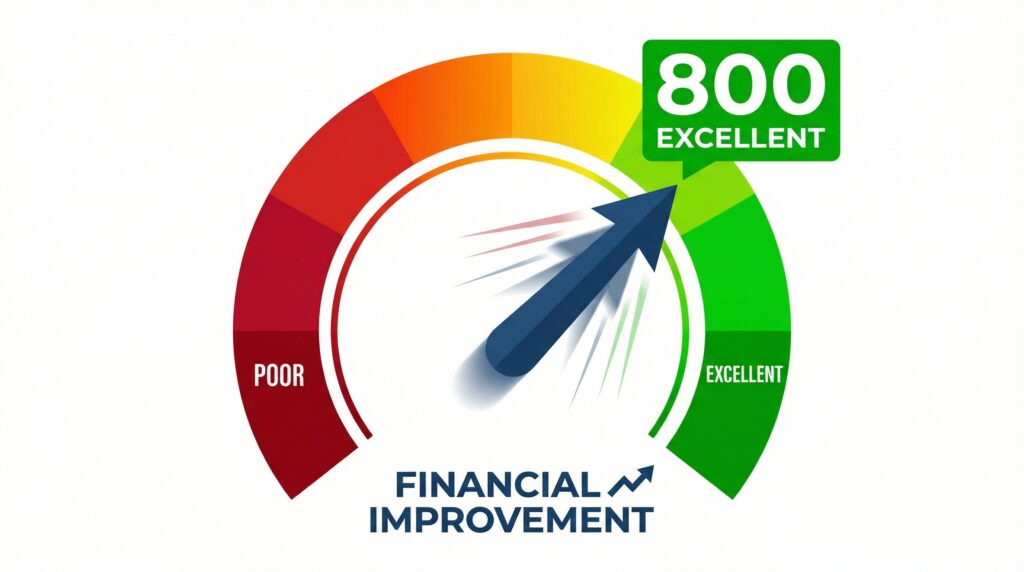
Two years after that embarrassing credit card rejection my score is in the excellent range. I’ve been approved for a travel rewards card with a strong cashback rate, refinanced my car loan at a much lower rate, and recently pre-qualified for a mortgage.
Every single one of those things was made possible — or made significantly cheaper — by having a good credit score.
The work I put in to fix it was a few hours spread over a month. The financial benefit has been thousands of dollars and counting.
Start today. Seriously. Even one action taken today starts the clock.
You might also like: How to Pay Off Credit Card Debt Fast | Best Savings Accounts UK 2025 | Zero-Based Budgeting for Beginners | How to Start Investing With $100