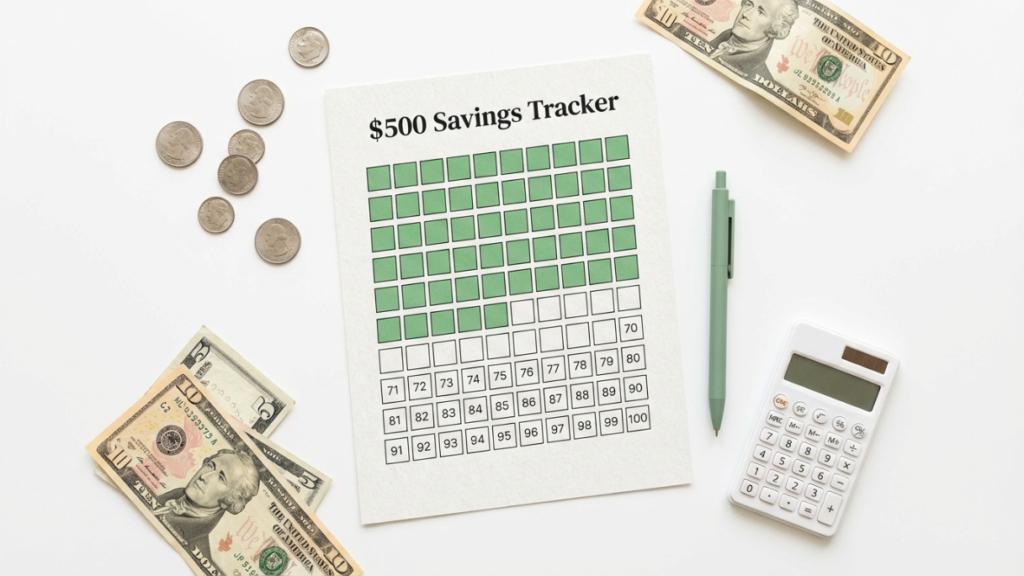
Let me be straight with you.
When I first heard the phrase ‘save $500 in 30 days’ I rolled my eyes so hard. Sounds like one of those Pinterest quotes that looks good on a pastel background but means absolutely nothing in real life, right?
But then I actually tried it. And I was genuinely shocked.
Not because it was easy. It wasn’t. But because I found money hiding in places I never thought to look. A gym membership I forgot I was paying for. Three streaming services — for one person living alone. A coffee habit that was quietly stealing $140 from me every single month.
One hundred and forty dollars. On coffee.
So yes — saving $500 in 30 days is absolutely possible. And no, you don’t need a high salary or some magic money trick to do it. You just need to know where to look — and actually be willing to look.
Wait — Is $500 in 30 Days Actually Realistic?
Fair question. And I’m not going to give you the usual ‘yes absolutely anyone can do it!’ cheerleader answer without backing it up.
Here’s the math. $500 divided by 30 days is $16.67 per day. That’s it. That’s your daily target.
Now think about your last week of spending. Be honest with yourself. Was there a takeaway you didn’t really need? A random Amazon order you’ve already forgotten about? A subscription renewing quietly in the background?
For most people the answer is yes. Multiple times over.
The U.S. Bureau of Labor Statistics says the average American household spends over $600 a month eating out and nearly $300 a month on subscriptions and entertainment. That’s $900 a month that could be redirected — at least temporarily — toward your $500 goal.
Step 1: Do the Honest Money Audit (Days 1 to 3)
This is the part most people skip. And it’s exactly why most people fail.
Before you cut anything or change anything — just look. Pull up your last two months of bank statements and go through every single transaction. No judgment. Just look.
I did this myself and found:
- A $14.99 subscription to an app I hadn’t opened in four months
- Two different cloud storage services doing basically the same thing
- A ‘free trial’ I forgot to cancel three months ago — now $19.99 a month
- Eight separate food delivery orders in one month. Eight.
That one audit found over $80 in money I was basically throwing away every month. And I thought I was pretty careful with money.
Here’s what to look for during your audit:
- Every subscription — streaming, apps, cloud storage, magazines, meal kits, everything
- Every dining out and takeaway charge — add them all up, the total will probably surprise you
- Any recurring charge you don’t immediately recognize — those are the sneaky ones
- Any purchases you made that you genuinely don’t remember or care about now
Write everything down. The total might sting a little. That’s fine. That sting is motivating.
Step 2: Make These 7 Cuts Right Now (Days 1 to 7)
Once you’ve done the audit you’ll probably already know what to cut. But here’s the list of highest-impact changes you can make immediately — some of these take literally two minutes:
Cancel at Least 2 Streaming Services
Be honest. Do you actually use all of them regularly? Pick your favourite one and pause the rest. You can always resubscribe later. Savings: $15 to $45 instantly.
Stop All Takeaways and Eating Out for 30 Days
I know. I know. This one hurts. But this single change is often worth $100 to $250 for most people. Cook at home for 30 days. You’ll survive. You might even discover you actually enjoy cooking — or at the very least you’ll enjoy the extra cash.
Cancel the Gym Membership You Don’t Use
If you’re going three times a week — keep it. If you’re going twice a month and mostly paying out of guilt — cancel it. YouTube has thousands of free workout videos. Your legs still work outside.
Make Coffee at Home
This one always causes arguments online. ‘Stop telling me to skip my latte!’ Look — I’m not saying never have nice coffee again. I’m saying that if you’re spending $140 a month at Starbucks and wondering why you can’t save money, those two things are related.
Apply the 72-Hour Rule to All Online Shopping
Before buying anything non-essential online — wait 72 hours. If you still want it after three days, maybe you buy it. But most of the time? You’ll forget about it completely. This trick alone saves most people $50 to $150 a month.
Switch to Generic Grocery Brands for 30 Days
For staples like pasta, rice, canned goods, cleaning products and cooking oil — the store brand is almost always identical to the name brand. Try it for one shop. Savings: $30 to $60 easily.
Pause Any Subscription Boxes
Meal kits, beauty boxes, wine clubs, book subscriptions — pause them all for 30 days. Every single one. You can restart them next month if you miss them.
Total potential savings from these seven cuts alone: $335 to $820. Yes really.
Step 3: Turn Your Clutter Into Cash (Days 4 to 14)
Here’s the thing about your home. It’s probably full of money you don’t realise you have.
The average American home contains over $3,000 worth of unused stuff sitting in closets, garages and drawers. Old phones. Clothes with the tags still on. Exercise equipment being used as expensive coat hangers. Books you’ll never read again.
All of that is cash waiting to happen.
Where to Sell Your Stuff Fast
- Facebook Marketplace — best for furniture, electronics, and anything local. Cash in hand, no shipping, no fees.
- eBay — best for branded items, collectibles, and anything with a niche audience willing to pay well.
- Poshmark or Depop — best for clothes, shoes, and accessories. Surprisingly easy.
- Craigslist — good for furniture and appliances if Facebook Marketplace is slow in your area.
What Sells Quickly
- Old smartphones — even broken ones. People buy them for parts. An old iPhone 11 can fetch $80 to $150.
- Clothes and shoes you haven’t worn in 6 months — if you haven’t worn it by now you won’t.
- Kitchen appliances gathering dust — that air fryer you used twice, the blender from 2018.
- Books and textbooks — especially anything educational or professional.
- Old video games and consoles — these sell faster than you’d think.
Set a goal of listing at least 10 items in your first week. Even if only half sell that’s real money fast.
Step 4: Pick Up a Small Side Income Boost (Days 7 to 21)
If the cuts and selling alone aren’t quite getting you to $500 — or if you want to get there faster — adding even a small income boost closes the gap quickly.
These are the fastest options that don’t require any special skills:
- Food or grocery delivery — DoorDash, Instacart or Uber Eats. Sign up on a Monday and you can be earning by Friday. A solid weekend of deliveries earns $150 to $300.
- TaskRabbit odd jobs — furniture assembly, moving help, cleaning, errands. $30 to $80 per task.
- Offer services to neighbors — lawn mowing, car washing, dog walking. Post on your local Facebook group tonight.
- Sell baked goods or homemade food locally — if you can cook well, people will pay for it.
- Plasma donation — pays $50 to $100 per visit at centers like BioLife or CSL Plasma.
You don’t need to do all of these. Pick one. Work it for two or three weekends. That’s often enough to close whatever gap remains after your expense cuts.
Your Week-by-Week Game Plan
Week 1 — The Audit and Cut Week
Do your full spending audit. Cancel subscriptions. List your first 10 items for sale. Begin cooking all meals at home. Target: save $100 to $150 this week.
Week 2 — The Hustle Week
Follow up on your sales listings. Sign up for one delivery app and complete your first weekend. Review your grocery spending. Target: save $125 to $175 this week.
Weeks 3 and 4 — The Lock-In
By now the habits are forming. Keep going. Do a second round of selling — look for items you missed the first time. Continue your side hustle on weekends. On day 30, transfer everything saved into a separate account. Target: save $200 to $250 across these two weeks.
What Should You Do With the $500 Once You Have It?
First — genuinely well done. Most people who start a savings challenge like this don’t finish it. You did.
Now don’t blow it.
Here’s what actually makes sense with $500:
- If you don’t have an emergency fund yet — this is it. The start of one. Aim to grow it to $1,000 next, then three months of expenses.
- If you have high-interest credit card debt — put it toward that. A $500 payment on a 22% APR card is like earning a guaranteed 22% return. Nothing beats that.
- If your emergency fund is solid — open a high-yield savings account and let it start earning 4 to 5% interest instead of the 0.01% your regular bank is probably paying you.
- What you should NOT do — immediately spend it on something non-essential because you ‘deserve a treat’. You do deserve something. But make it small. $20 dinner, not a $500 shopping spree.
Quick Answers to Questions I Get Asked a Lot
Is saving $500 in 30 days actually possible for someone on minimum wage?
Honestly — it’s harder but not impossible. The combination that works best for lower incomes is aggressive expense cutting plus selling items plus one weekend of side hustle income. It might take 35 or 40 days instead of 30. That’s fine. The point is to build the habit and break the paycheck to paycheck cycle — not to hit an arbitrary deadline.
What if I try all this and still don’t reach $500?
Then you saved $200 or $300 that you wouldn’t have saved otherwise. That’s still a win. The habits you build in this 30-day challenge compound over time. Month two is always easier than month one.
Do I need any special app or tool to do this?
Nope. A notebook and a pen work perfectly fine. If you want an app, Mint is free and automatically tracks everything. But honestly — a notebook on your kitchen counter that you actually look at beats a fancy app you never open.
The Bottom Line
Saving $500 in 30 days isn’t magic. It’s not a hack. It’s not passive income or a get-rich scheme.
It’s just deciding — for 30 days — to be really intentional about where your money goes instead of wondering where it went.
Cancel one subscription today. List one item for sale tonight. Make coffee at home tomorrow morning.
That’s how it starts. That’s how it always starts.
You might also like: Best Side Hustles From Home 2025 | How to Pay Off Credit Card Debt Fast | Zero-Based Budgeting for Beginners | How to Make a Budget for Beginners