
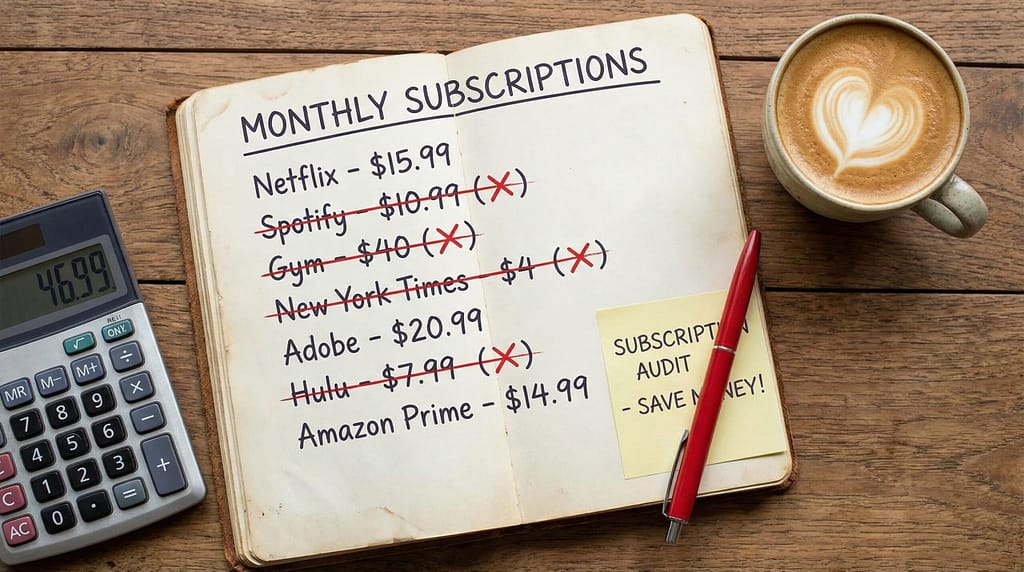


I audited my subscriptions and found $187 a month I’d completely forgotten about. Here’s how to find your hidden subscription spending and cut it down to size.
Category: Saving Money | Tags: save money on subscriptions, cancel subscriptions, subscription audit, stop subscription spending, cancel unused subscriptions, reduce monthly bills, subscription creep
Subscription creep is one of the quietest financial leaks in modern life.
It doesn’t announce itself. It doesn’t feel like spending. It just quietly happens in the background — one small monthly charge at a time — until you’ve committed hundreds of dollars of your income to services you barely use or have completely forgotten about.
When I did my first proper subscription audit I found $187 per month in recurring charges. Some I was actively using. Some I vaguely knew about. But at least $90 worth I had genuinely forgotten existed entirely.
$90 a month. $1,080 a year. On things I wasn’t even using.
The Subscription Problem Nobody Talks About
Subscriptions are designed to be forgettable. Companies know that the harder they make it to notice you’re paying, the longer you’ll pay. This is why charges are small, monthly, and hidden in the middle of your bank statement between hundreds of other transactions.
The average American now spends $219 per month on subscriptions according to a 2023 C+R Research survey. And the average American thinks they’re spending $86. The gap between perception and reality is $133 per month — $1,596 per year.
How to Do a Full Subscription Audit in One Sitting
- Pull up your last three months of bank and credit card statements — not just one month, because some subscriptions are quarterly or annual
- Highlight every recurring charge — look for the same merchant name appearing multiple months in a row
- Make a list of every subscription found — include the amount, the service, and when it last renewed
- For each one ask three questions: Do I actively use this? Could I live without it for 30 days? Is there a free alternative?
- Cancel everything you can’t say yes to for the first two questions
Use a free tool like Rocket Money (formerly Truebill) in the US or Emma in the UK to automate this — they scan your transactions and identify subscriptions automatically.
The Subscriptions Most People Forget They’re Paying For
From my own audit and conversations with others here are the most commonly forgotten subscriptions:
- Free trials that converted to paid — you signed up for a free month and forgot to cancel
- Old app subscriptions — apps you downloaded once, used twice, and forgot about
- Multiple cloud storage services — Google One and iCloud and Dropbox all running simultaneously
- Duplicate streaming services — two music services, three video services, all overlapping
- Magazine and news subscriptions from a link you clicked on once
- Software subscriptions from a project you finished months ago
- Gym or fitness app subscriptions you use occasionally but not regularly enough to justify
- Premium versions of apps you could use the free version of perfectly well
The Smart Way to Manage Subscriptions Going Forward
Create a Subscription Tracking System
Keep a simple list of every subscription you have — name, cost, renewal date, and whether you’ve used it in the last 30 days. Review it once a month. This takes 5 minutes and prevents subscription creep from silently building up again.
Use One Card for Subscriptions Only
A dedicated card for all recurring charges makes them easy to review in one place. When you get a statement from that card you see all your subscriptions together and can assess the total without hunting through general spending.
Set Calendar Reminders Before Free Trials End
Every time you start a free trial set a calendar reminder for 2 days before the trial ends. Either decide to keep it consciously or cancel before you’re charged. This one habit eliminates almost all accidental trial-to-paid conversions.
Negotiate or Pause Before Cancelling
Before cancelling a subscription you actually use but can’t currently afford — call and ask about options. Many services offer pause options, reduced plans, or retention discounts of 20 to 50% to customers who say they’re thinking of cancelling. Netflix, Spotify, gym memberships, and software subscriptions have all been known to offer deals when asked.
Subscriptions Worth Keeping vs. Worth Cutting
Not every subscription should be cancelled. Some genuinely add value and are worth the cost. Here’s my honest framework for deciding:
Keep it if: You use it at least once a week, there’s no free alternative that meets your need, or the cost per use works out to less than $1 to $2.
Cut it if: You haven’t used it in the last 30 days, a free version exists that meets 80% of your needs, or you subscribed mainly because it seemed cheap at the time.
How Much Can You Realistically Save?
Based on the $219 average monthly subscription spend — and the research showing most people underestimate by $133 — a thorough audit with some cuts typically saves people $60 to $150 per month.
At $100 per month that’s $1,200 per year. Invested at 8% that’s over $7,000 in 5 years.
Quick Answers
What is the best free app to track subscriptions?
In the US: Rocket Money (free basic version) scans your bank transactions and identifies all recurring charges automatically. In the UK: Emma app connects to your bank and highlights subscriptions clearly. Both are free to use at the basic level and take about 10 minutes to set up.
How do I cancel subscriptions that are hard to cancel?
Some companies deliberately make cancellation difficult — requiring phone calls, finding hidden cancel buttons, or using dark patterns. For truly difficult cancellations: use your bank or card’s subscription blocking feature, request a chargeback for charges on cancelled services, or for US subscribers use Privacy.com virtual cards that you can pause or cancel instantly.
The Saturday Morning I Found $187
I did my subscription audit on a Saturday morning over coffee. It took about 45 minutes. I went through three months of statements and built the list. By the time I was done I’d identified $187 in monthly charges — and immediately cancelled $90 worth that afternoon.
The remaining $97 I kept because I actively use those services and they genuinely add value to my life. But the $90 — the forgotten gym app, the cloud storage I had three of, the free trial that became $14.99 per month nine months ago — that was just gone. Silently.
Related: How to Stop Impulse Buying | How to Make a Budget for Beginners | How to Cut Monthly Expenses | Zero-Based Budgeting for Beginners