
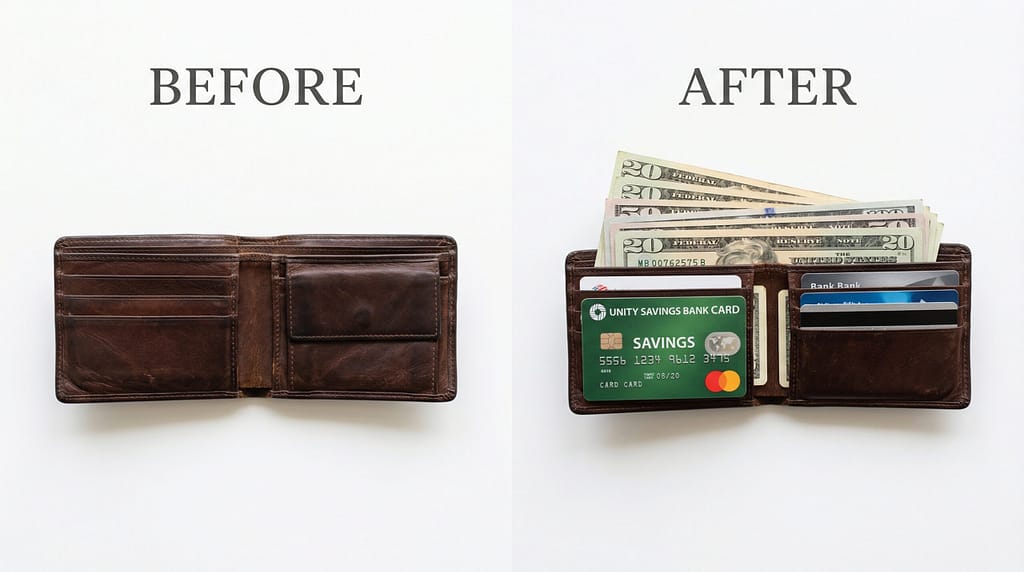


Being broke isn’t just about income. I was broke on a decent salary for years. Here’s what actually changed my financial situation — honest, practical, and no fluff.
Category: Budgeting | Tags: how to stop being broke, stop living paycheck to paycheck, break broke cycle, how to get financially stable, stop being poor, financial stability tips, broke to stable
I want to say something that most financial articles won’t say: being broke is not always about how much money you earn.
I was broke on a salary of $52,000 per year. I had friends on $28,000 who were more financially stable than me. The difference wasn’t income. It was what each of us did with what we had.
Understanding that was uncomfortable. Because it meant the problem was solvable but it also meant it was my problem to solve.
Being Broke Is a Pattern, Not Just a Number
Broke is not a specific income level. It’s a pattern of money behaviour that results in always running out regardless of what comes in.
The pattern looks like this: money comes in, money goes out on unplanned spending, something unexpected happens and there’s nothing to cover it, you go into debt, debt payments add to next month’s pressure, repeat.
Breaking that pattern requires changing specific behaviours — not waiting for a pay rise.
Change 1 — I Faced the Actual Numbers
The first thing I did was something I’d been avoiding for two years: I sat down and calculated exactly what I owed, exactly what I earned, and exactly what I was spending.
Knowing the number — the real, total, full number — was painful. But it was also the moment the pattern started breaking. You cannot solve a problem you haven’t looked at directly.
Change 2 — I Built $500 Before Anything Else
Before I paid extra debt. Before I invested. Before I changed anything else about my spending. I saved $500 in a separate account and I didn’t touch it.
The reason this matters: every time something unexpected happened before I had this buffer I went to my credit card. The credit card made the month worse. The worse month made saving harder next month. The $500 breaks this specific loop.
Change 3 — I Made a Budget That Was Actually Honest
My previous budgets failed because they were aspirational, not realistic. I budgeted $200 for food when I was actually spending $380. I budgeted $50 for entertainment when I was spending $180.
An honest budget starts with what you’re actually spending — not what you wish you were spending. Only from that honest baseline can you make meaningful changes.
Change 4 — I Automated the Saving
Every payday, before I could spend it, a fixed amount transferred automatically to my savings account. Starting at $50, which felt embarrassing but was real.
Automation removes the daily decision. You don’t have to choose to save every month. It just happens. And the absence of the money from your checking account means you adapt your spending to what’s left — without even trying.
Change 5 — I Attacked One Debt Aggressively
I had three debts. I chose the smallest one and threw every spare dollar at it for three months. When I paid it off I felt something I hadn’t expected: genuine momentum.
That payment freed up $85 per month that had been going to that debt. I immediately redirected all $85 to the next debt. This is the debt snowball in practice. It works because it’s psychologically powerful, not just mathematically sound.
Change 6 — I Stopped Spending to Feel Better
This was the hardest one to admit. A significant portion of my spending was emotional. Bad day at work: order food delivery and buy something online. Anxious weekend: browse shops and buy something I didn’t need.
Identifying this pattern didn’t immediately fix it. But it meant I could start catching it. When I felt the urge to spend in response to a feeling — I started asking: what am I actually trying to feel right now, and is there a cheaper way to get there?
Change 7 — I Added One Small Income Stream
I started freelance writing on evenings and weekends. Not instead of my job — alongside it. The first month I earned $180 extra. The second month $240. Within six months it was consistently $600 to $800 per month.
Having extra income hit differently than I expected. It wasn’t just the money. It was knowing I could generate income beyond my salary. That knowledge changes how financial stress feels. It went from trapped to temporary.
How Long Before Things Changed?
Month one felt the same as before except I had a budget and $50 in a savings account.
Month three I paid off my first debt. Had $300 in savings. The pattern was starting to break.
Month six my savings were $1,200. Two debts cleared. Side income consistent. The word broke stopped feeling like it applied to me.
Quick Answers
What’s the first step to stop being broke?
Write down every number: income, every debt with its balance and interest rate, and every monthly expense. Total them honestly. This single act of facing the reality — which most people avoid for years — is genuinely the first step. You cannot fix a problem you refuse to look at.
Can you stop being broke without earning more money?
For most people yes — but with limits. If your income genuinely cannot cover basic needs, no amount of budgeting fixes that and increasing income becomes the priority. But for most people on modest salaries, the gap between broke and stable is found through spending awareness, debt elimination, and savings automation rather than requiring a higher income.
Related: How to Budget When Paycheck to Paycheck | How to Build Emergency Fund Fast | Zero-Based Budgeting for Beginners | How to Pay Off Credit Card Debt Fast