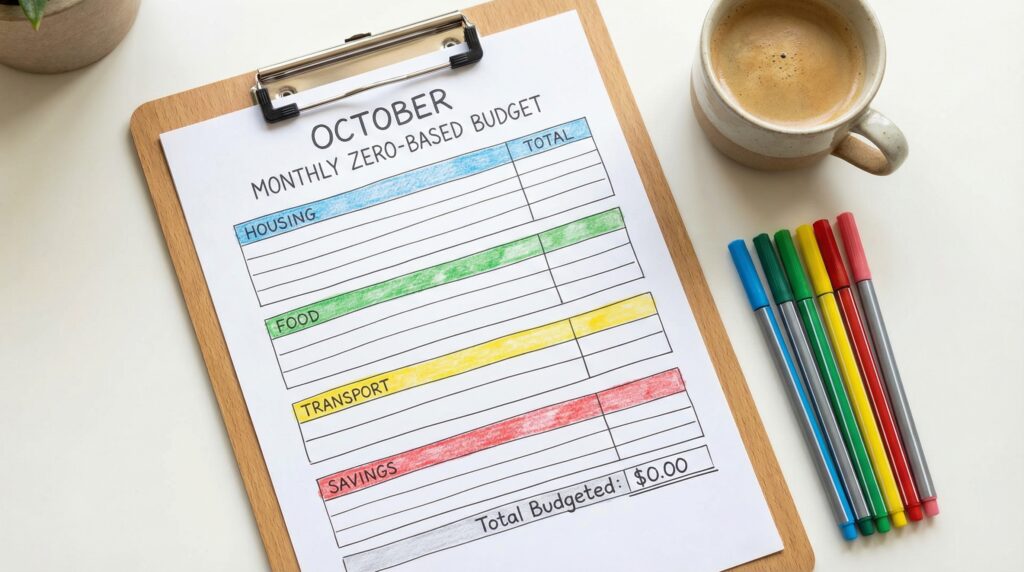
I made a budget four times before zero-based budgeting.
The first time I downloaded a fancy template off Pinterest, spent an afternoon filling it in, and then never looked at it again.
The second time I bought a budgeting journal. Used it for eleven days.
The third time I downloaded Mint and connected my bank accounts. It was great at showing me exactly how badly I was managing money. Less great at actually helping me change.
The fourth time I tried the 50/30/20 rule. It looked sensible. It lasted about three weeks until an unexpected expense blew it apart and I gave up entirely.
Then someone mentioned zero-based budgeting in a Facebook group I was in. I was sceptical. Another budgeting system that sounds logical but doesn’t survive contact with real life?
I was wrong. This one was different.
So What Actually Is Zero-Based Budgeting?
The concept is simple enough to explain in one sentence: you give every single dollar you earn a specific job before the month begins — until there’s nothing left unassigned.
The formula is: Income minus all expenses and savings equals zero.
That zero doesn’t mean you have no money. It means no money is sitting around unaccounted for — waiting to be spent on things you didn’t consciously choose.
Traditional budgeting looks at what you spent last month and tries to spend less. Zero-based budgeting tells your money where to go before you get the chance to spend it on something stupid.
Why Every Budget I Tried Before Failed
Here’s the thing I eventually realised about my previous budgeting failures. Every single one had the same problem.
I was tracking spending. I wasn’t directing it.
There’s a fundamental difference. Tracking tells you where money went. Directing tells it where to go. Tracking is looking in the rearview mirror. Directing is steering the wheel.
Zero-based budgeting is steering. And once I understood that distinction — really understood it — everything clicked.
How to Build Your First Zero-Based Budget: Step by Step
Step 1: Know Exactly What Comes In
Start with your actual take-home income. Not gross salary. Not what you think you earn. The actual number deposited into your account each month after taxes and deductions.
If your income varies — freelance work, tips, commissions — use your lowest month from the past six months as your baseline. Always budget conservatively. If you earn more than expected, great. That’s a bonus you assign somewhere useful.
Step 2: Write Down Every Single Expense
Every. Single. One.
This is where most budgets fail — people forget stuff. So here’s a more complete list than most budgeting guides give you:
- Fixed monthly bills: rent, mortgage, utilities, phone, internet, insurance, subscriptions
- Variable monthly needs: groceries, fuel, medical, personal care
- Irregular expenses you need to plan for: car registration, annual insurance renewals, Christmas, birthdays, holidays — divide by 12 and save monthly
- Debt payments: all minimum payments plus any extra you’re putting toward debt
- Savings: emergency fund, specific savings goals
- Investments: retirement contributions, investment account
- Personal spending: dining, entertainment, clothing, hobbies
That last category — personal spending — is the one most budgets underestimate. Be generous here or you’ll overspend and blow the whole budget by week two.
Step 3: Assign Every Dollar Until You Hit Zero
Now subtract every expense from your income. Keep going until you reach exactly zero. If you run out of expenses before you run out of income — amazing. Assign the surplus to savings, extra debt payments, or a specific financial goal.
If you run out of income before you run out of expenses — that’s important information. You need to either cut something or find more income. The budget is telling you the truth. Listen to it.
Step 4: Track Every Spend Throughout the Month
Making the budget is maybe 20% of the work. The other 80% is tracking.
Every time you spend money — note it against the relevant category. Check your budget every few days. Are you on track? Have you overspent in any category?
Best free apps for tracking: EveryDollar (free version), YNAB (free trial), or an honest-to-goodness notebook on your kitchen counter.
Step 5: Adjust Every Month
Your first month will be wrong. That’s completely normal. You’ll forget expenses. You’ll underestimate categories. You’ll have one-off costs you didn’t plan for.
That’s fine. Take notes. Adjust for next month. By month three your budget will be genuinely accurate and useful. By month six it’ll feel completely natural.
A Real Zero-Based Budget Example
Here’s what a zero-based budget actually looks like for someone taking home $3,500 a month:
- Rent: $1,050
- Groceries: $350
- Utilities and phone: $180
- Transport — fuel plus insurance: $280
- Health insurance: $150
- Minimum debt payments: $200
- Dining and entertainment: $150
- Personal care and clothing: $75
- Emergency fund savings: $300
- Retirement (Roth IRA): $250
- Extra debt payoff: $215
- Miscellaneous buffer: $100
- TOTAL: $3,500 — every dollar assigned
See how nothing is left floating? Every dollar has a destination. That’s zero-based budgeting.
The Honest Pros and Cons
What I Love About It
- The end-of-month wondering where my money went stopped completely — I always know
- My debt payoff accelerated because every leftover dollar gets assigned somewhere useful
- It forces a conversation about priorities — you can’t fit everything in and that’s the point
- After three months it takes about 20 minutes at the start of each month — not as time-consuming as it sounds
What’s Hard About It
- The first month genuinely takes about an hour and feels overwhelming
- Variable income makes it trickier — you have to be disciplined about using the conservative estimate
- If you overspend a category mid-month you have to consciously move money from somewhere else — some people find this annoying, others find it clarifying
Common Questions
Is zero-based budgeting good for beginners?
It’s probably the best system for beginners specifically because it forces you to look at your finances honestly from day one. The learning curve is real but short. Most beginners say month two feels much easier than month one.
What’s the best free zero-based budgeting app?
EveryDollar has a free version that’s excellent for zero-based budgeting beginners. YNAB is more powerful but costs $14.99 a month — worth it for most people once they’re committed to the system.
Zero-based budget vs 50/30/20 — which is better?
50/30/20 is easier to start. Zero-based is more effective long-term. If 50/30/20 is the first step through the door then zero-based is where you end up when you’re serious about controlling your money.
The Month Everything Changed
Three months into zero-based budgeting I had my first ever month where I reached my savings goal. Actually reached it. In full.
It sounds small. But I’d been trying to save consistently for two years before that. Something about knowing exactly where every dollar was going — and having made that decision intentionally at the start of the month — meant I actually followed through.
That’s the magic of this system. It doesn’t restrict your spending. It makes your spending intentional. And intentional spending is spending you don’t regret.
You might also like: Best Free Budgeting Apps 2025 | How to Budget When You Live Paycheck to Paycheck | How to Make a Budget for Beginners | How to Save $500 in 30 Days